
Businesses that develop rapidly tend to become disorganised. Redundancies emerge, different standards are adopted throughout the organisation, and skills that are present in one area of the company remain unused in others. The Center of Excellence (CoE) is the organisational design solution to this issue.
If you run an American company looking to create an analytics centre, a multinational firm seeking to streamline its supply chain processes, or an emerging small or medium-sized enterprise looking to adopt an offshore delivery model, then you will need to learn what a properly built CoE is.
This guide will teach you everything you need to know about Centers of Excellence, including their definition, existing models, creation process, and how offshore CoEs, including the Virtual Captive Center of Optimar Consulting, provide businesses with a competitive edge.
Offshore Virtual Captive Center
What Is a Center of Excellence (CoE) in Business?
A Center of Excellence is a special team within a business organization that acts as a leader on behalf of a particular focal point by providing best practices, leadership, research, and training. As per the definition given by the Project Management Institute, a Center of Excellence is “a collection of individuals with specialized skills and expertise acting as a leader in purposefully transferring knowledge across organizations.”
In essence, a Center of Excellence is a source of internal knowledge that other individuals will turn to for help. It is not a temporary project team, but rather a permanent or ongoing function within an organization.
Center of Excellence (CoE) – Definition
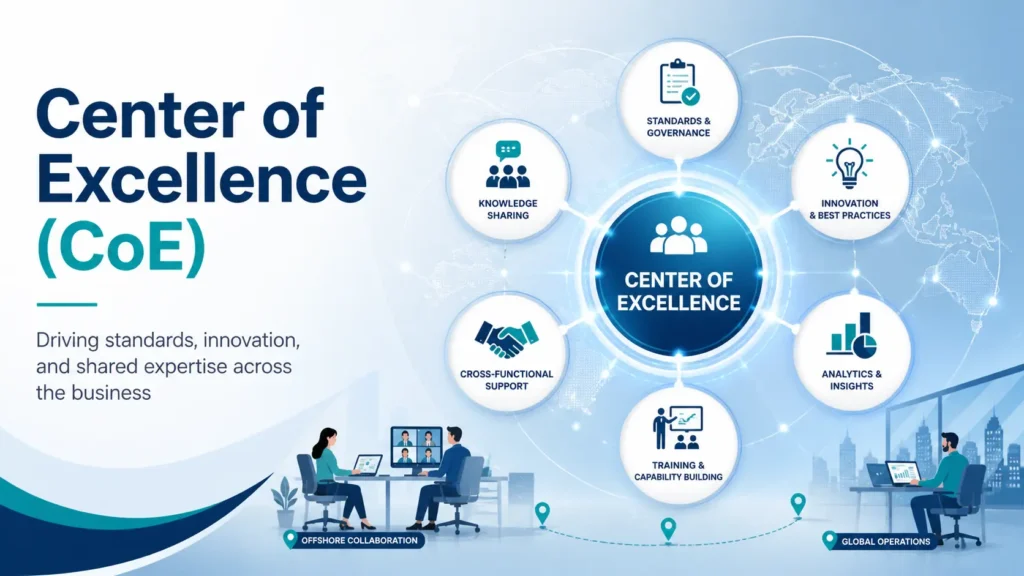
A Center of Excellence is a specialized team or unit within an organization that sets best practice standards, drives innovation, and shares expertise in a specific business area.
What Is the CoE Meaning and Where Did It Originate?
The term Center of Excellence initially described institutions that showed remarkable performance in a specific subject area. Corporations began using it in the 1990s when companies such as General Electric, Alcoa Inc., and International Business Machines Corporation implemented CoEs to create consistency.
In contemporary business practices, small, medium, and large businesses use CoEs across industries such as information technology, logistics, human resources, and offshore outsourcing.
How Is a CoE Different from a Regular Department?
A department owns routine operations and day-to-day delivery. A CoE owns standards, knowledge, and capability that exist to make every other team better at what they do. A CoE is also typically cross-functional: it draws on expertise from multiple departments and serves the whole organization, rather than managing a fixed team of direct reports.
- Department: manages people and delivers outputs
- CoE: sets standards, shares expertise, and drives improvement across teams
- CoE: operates with a strategic mandate, not just operational targets
- CoE: often includes external expertise such as offshore specialists or consultants
What Are the Main Types of Center of Excellence Models?
Organizations typically use four established CoE models, depending on their size, structure, and objectives.
| Model | How it works | Best for | Optimar equivalent |
|---|---|---|---|
| Centralized | One team owns and governs all standards company-wide | Large enterprises with uniform processes | Single offshore VCC team managing one function |
| Federated | Teams across departments collaborate under a shared framework | Multi-divisional organizations with varied needs | Multiple offshore teams per division shared governance |
| Hub and Spoke | A central unit supports regional or functional sub-teams | Global organisations scaling across regions | Central VCC hub with country or function-specific spokes |
| Virtual CoE | Distributed experts connected through shared platforms and governance | Remote-first and offshore-first organizations | Optimar’s Virtual Captive Center model was built for this |
Which CoE Model Is Right for Your Organization?
For small organizations and SMEs, a typical choice is a centralized CoE, which means one CoE and one mission. For larger companies with divisions or different regions, having a federated or hub-and-spoke CoE makes more sense. Companies looking to build capabilities offshore and those looking to save on costs without compromising on control are moving towards a Virtual CoE, in which a specially formed offshore team acts as the CoE.
Global Capability Centers: A Complete Guide
What Does a Center of Excellence Actually Do?
There are many different tasks that CoEs undertake depending on their area of specialization. However, according to TechTarget, the general objective of a CoE lies in the eradication of inefficiencies, which will allow the organization to advance to the next stage of the maturity model.
- Define and document best practices and standard operating procedures
- Train and upskill teams across the organisation in the CoE’s focus area
- Offer advisory services for complicated projects or programs
- Evaluate the performance and measure results using established KPIs
- Trial innovative solutions, processes, or techniques before deployment
- Foster cross-departmental cooperation and information exchange
- Govern compliance, risk, and management in the specific field
What Roles Are Typically in a CoE Team?
The CoE should have a balanced composition of strategic, technical, and operational roles. According to the Project Management Institute and industry experts, a CoE usually includes the following roles:
- CoE Leader/Champion – establishes the vision for the CoE, obtains executive buy-in, and links the CoE’s objectives to organizational strategies.
- Subject-Matter Experts/Coaches – experts in their respective field of practice who conduct training, reviews, and coaching.
- Process Owners/Architects – establish and maintain the standards and processes, as well as continuously improve the frameworks.
- Stakeholders’ Representatives – representatives that link the CoE with its stakeholding business units.
- Analysts/Data Stewards – measure, govern, and report on performance data.
What Are the Benefits of Building a Center of Excellence?
The justification for establishing a CoE is quite clear. According to a survey cited by Gartner, operational excellence accounts for 31% of marketing spending, yet its impact on performance varies widely. The difference between organizations that see strong returns and those that do not is typically the presence of a structured CoE.
31% The percentage of marketing budget goes towards operational excellence, yet effectiveness differs greatly without having a well-structured CoE (Gartner)
Benefits of an effectively managed CoE include:
- No duplication – no repetition in solving issues by individual groups
- Accelerates innovation – a dedicated team can experiment without day-to-day operational pressure
- Improves consistency because the team defines standards once and applies them everywhere.
- Reduces costs – shared expertise and reusable assets lower per-project spend
- Builds institutional knowledge because the organization retains expertise instead of losing it when individuals leave.
- Achievement of tangible results – CoEs measure their success through key performance indicators (KPI), not mere activities
How Does an Offshore Center of Excellence Work in Practice?
Offshore Centers of Excellence have emerged as one of the most popular business models today, especially for American, British, and Australian companies that are scaling up their capability requirements without increasing the cost of local hiring. India is currently home to about 3.53 million software developers and 501,000 artificial intelligence and machine learning developers (Zinnov, 2026).
The mechanism of working of an offshore Center of Excellence consists of placing the team of specialists that you require in a specific area at a more economical place. This team will work on your guidelines and deliver directly to you using your tools and methodologies.
3.53M Availability of software engineers in India makes it the world’s best offshore CoE talent pool (Zinnov, 2026).
Center of Excellence for AEC and Preconstruction
What Is the Difference Between a CoE and a Global Capability Center (GCC)?
These two concepts have many things in common, but are not the same. The Global Capability Center (GCC) refers to an overseas unit set up by a multinational firm for carrying out some critical business activities, which is basically a wholly-owned subsidiary operating offshore for the firm. A CoE may be part of a GCC, but it could also be a smaller group handling a certain task.
The practical difference for most SMEs and mid-market companies is that setting up a GCC requires significant investment, legal infrastructure, and long timelines. A CoE delivered through Optimar Consulting’s Virtual Captive Center model gives you the strategic benefits of a GCC dedicated team, full control, and deep integration without the administrative and legal overhead.
What Is a Virtual Captive Center and How Does It Relate to a CoE?
A Virtual Captive Center (VCC) is Optimar Consulting’s flagship delivery model for offshore CoEs. Instead of establishing a legal presence in another nation, your company will get its own offshore team, which will be completely managed by Optimar, with HR, payroll, agreements, and regulatory aspects being managed without requiring your company to have its own in-house center of excellence.
This kind of structure is perfect for businesses that want both the advantage of an in-house center of excellence and offshore staff at reduced costs. Our clients save around 70% on operational costs versus the local solution, and there is no regulatory obligation or minimum team size requirement.
How Do You Build a Center of Excellence Step by Step?
A CoE is built systematically. Onshore or offshore, the following steps remain the same:
- Mandate. Determine what kind of CoE you will have. This could be IT, analytics, project controls, supply chain, or even a cross-functional one like an offshore delivery center. What problem does it solve, and what are its outcomes?
- Get executive sponsorship. Without a CoE that receives C-level backing, forget about the project. Name the sponsor responsible for knocking down roadblocks for the CoE.
- Defining governance and roles. Determine who will own the standards, train the employees, manage relationships with stakeholders, and make decisions. Otherwise, without defined roles and responsibilities, the CoEs will wander.
- Form the team. Recruit the right personnel with the help of Optimar Consulting, if it is being established in an offshore location; subject-matter experts, process owners, and analysts are a must.
- Defining KPIs. Establish measurable outcomes and objectives before beginning the CoE development process. These can include cost savings, process cycle times, adoption rates, quality scores, and any other indicator that matches the CoE mandate.
- Piloting, learning, and scaling. Run a pilot project for a smaller subset, a single team or a business unit, gather insights, refine the concept, and then roll it out to the whole organization.
What Are the Most Common CoE Mistakes to Avoid?
The majority of CoEs fall flat for these three reasons, as noted by TechTarget and experts in the field:
- No executive buy-in – a CoE that cannot get senior support will be ignored, underfunded, and eventually disbanded
- Failure to standardise – if departments cannot agree on shared standards, the CoE’s core value proposition collapses
- Becoming a bottleneck – when every request requires CoE approval, the function slows the business rather than accelerating it. The best CoEs define clear guardrails for what needs review and what teams can self-serve
- Measuring activity, not outcomes – tracking the number of training sessions run is not the same as measuring performance improvement. CoEs must connect their work to business results
- Building too large too fast – most effective CoEs start small, prove value, and scale. A simple, accountable CoE beats an enormous team without a defined mission
Key Takeaways
- Center of Excellence (CoE) is a special unit that is responsible for setting standards, being innovative, and exchanging knowledge for an organizational function, thereby avoiding duplication and improving efficiency throughout the organization.
- There are mainly four types of CoEs, namely Centralized, Federated, Hub and Spoke, and Virtual.
- Operational excellence accounts for 31% of marketing spend, but its impact varies widely without a structured CoE (Gartner).
- Offshore CoEs, particularly in India, which has 3.53 million software engineers, are the fastest-growing CoE delivery model for US, UK, and Australian companies in 2026 (Zinnov).
- Optimar Consulting’s Virtual Captive Center model delivers all the benefits of a dedicated CoE at up to 70% lower cost than building locally with zero compliance overhead.
- The most common CoE failures are a lack of executive buy-in, failure to standardise, and measuring activity instead of outcomes.
Ready to Build Your Centre of Excellence?
Optimar Consulting builds Virtual Captive Centers that operate as your dedicated offshore CoE, fully managed, fully integrated, and up to 70% more cost-effective than building locally. Join 200+ global teams that have already made the switch.